Hurroz

Hurroz

@hurroz

15 articles · Joined Feb 19, 2026

Spotlight articles

Same Body, Same Job. Different Person.

Same Body, Same Job. Different Person.

Monday morning, your brain decides it's a different person who's about to do this. Same body. Same job. Same bills. Nothing actually changed — and yet gym visits jump 33% at the start of a week, and people who turn 29 train harder for marathons than people who turn 30. The strange part isn't that it works. It's what it's quietly doing to the rest of the week.

🦋 1
Comments1

Six Reasons We Are Not Ready for Autonomous AI Doctors

Six Reasons We Are Not Ready for Autonomous AI Doctors

JAMA just published a proposal to license AI as autonomous clinical practitioners — to diagnose, recommend treatment, and triage without a doctor reviewing each case. The authors are serious people. The shortage of doctors is real. The AI capabilities are real. But there are six things that have to be true before we hand the visit over to the machine. None of them are true yet. This is the careful version of why.

Comments

When the Robot Was Kinder Than the Doctor

When the Robot Was Kinder Than the Doctor

We always thought computers might beat doctors at finding diseases. Not at being warm. A 2026 JAMA paper says AI chatbot replies now score higher than doctor replies on empathy. The chatbot did not learn to care. The doctor got buried under paperwork. The real question is what AI is for — and what it absolutely is not.

Comments

When the Mind Won't Stop, a Gratitude Practice Can Help

When the Mind Won't Stop, a Gratitude Practice Can Help

Gratitude journals get pitched as a practice for already-happy people. The 2025 research suggests something more interesting. When 352 people with stuck, looping minds were given a small daily gratitude practice, the loops got quieter. The people who needed it most got the most out of it. A practice that meets you on a hard day might not look like the one we have been sold.

Comments

Why Writing About Hard Things Heals — And the Small Shift That Helps

Why Writing About Hard Things Heals — And the Small Shift That Helps

Writing about painful experiences has been shown to help mental and physical health for over thirty years. A 2025 study on grief adds something new. When people wrote about their loss for fifteen minutes a day for three days, they felt better. And those who wrote in the third person — using their own name instead of "I" — broke free of the loop of grief rumination. A small word change. A real difference.

Comments

Why You Forget What You Walked Into the Kitchen For

Why You Forget What You Walked Into the Kitchen For

You walk into the kitchen. You forget why. It happens at every age, to every kind of brain. There's a famous explanation — something about doorways slicing your memory in two. The strange part? Recent research keeps finding the doorway alone doesn't really do it. Something else does. And that something else turns out to be quietly useful for anyone who sits down to write at the end of a long day.

Comments

I Used to Think Depression Was About Sadness. This Study Changed My Mind

I Used to Think Depression Was About Sadness. This Study Changed My Mind

For most of my life I thought of depression as a presence — sadness that needed to be lifted. A 2026 study in JAMA Network Open by researchers at SMU and UCLA suggests the opposite framing may be closer to the truth. Anhedonia, the loss of pleasure, may be the more disabling feature, and treating it directly may matter more than treating sadness alone.

Comments

Turning-Point Writing: A New Evolution of the Pennebaker Protocol

Turning-Point Writing: A New Evolution of the Pennebaker Protocol

For four decades, the Pennebaker expressive writing protocol has shaped how we think about journaling for healing. A 2025 study introduces a meaningful refinement: turning-point writing. Instead of writing about a stressful experience for four sessions, participants wrote about a single life-changing moment. The findings suggest this narrower focus may produce stronger outcomes for emerging adults. We explore what changed, why it matters, and how to try it.

Comments

Master Your Emotions with Hurroz: Turn Thibaut Meurisse’s 4-Part Blueprint into Daily Practice

Master Your Emotions with Hurroz: Turn Thibaut Meurisse’s 4-Part Blueprint into Daily Practice

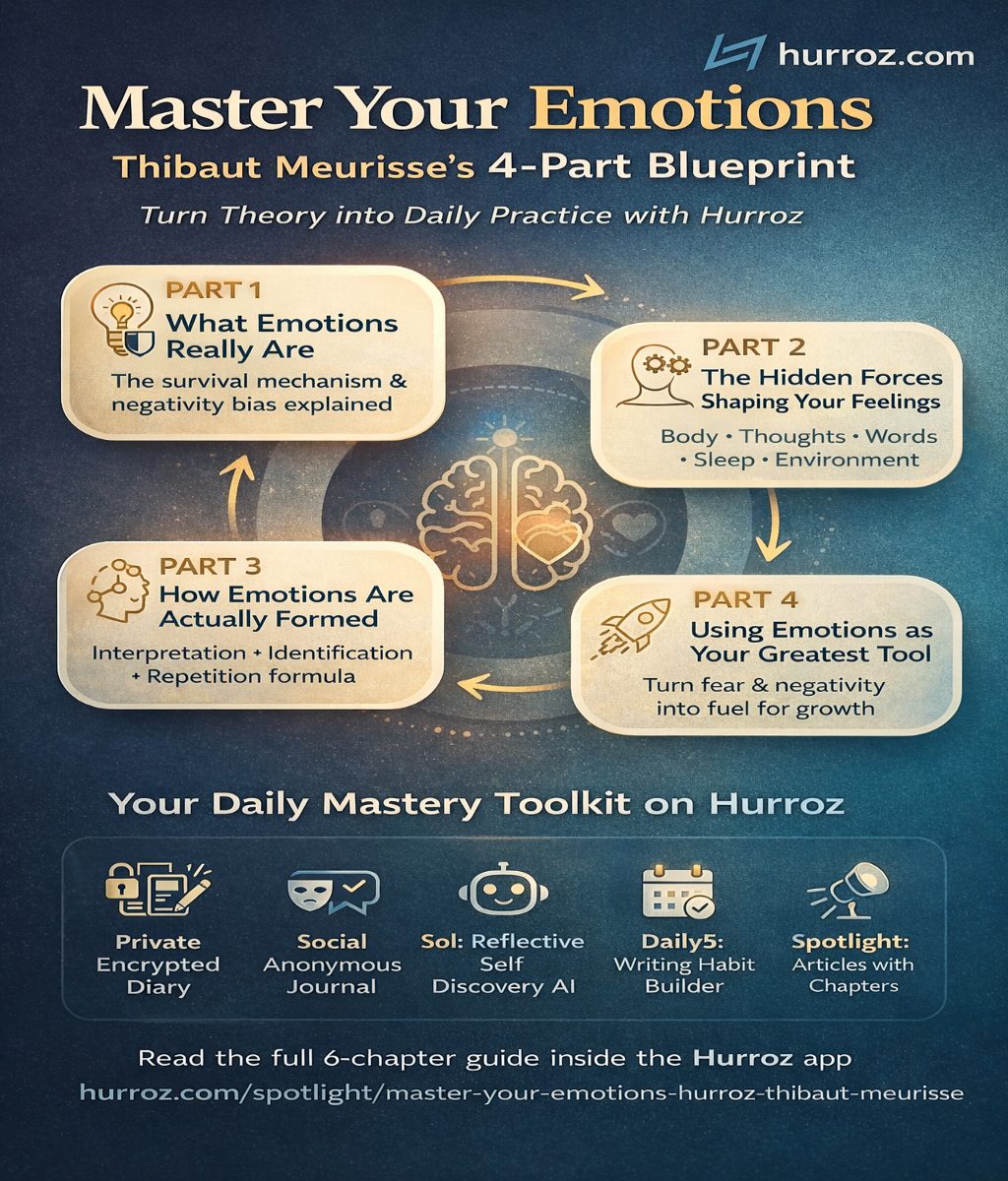
Discover how Thibaut Meurisse’s bestselling book Master Your Emotions can be turned into daily habits using Hurroz’s Private Encrypted Diary, Social Anonymous Journal, Sol Reflective AI, Daily5 writing streaks, and Spotlight articles. A complete 6-chapter guide for emotional mastery.

Comments

Unlocking Dramatic Mastery: Timeless Lessons from Lajos Egri

Unlocking Dramatic Mastery: Timeless Lessons from Lajos Egri

Lajos Egri’s The Art of Dramatic Writing remains the essential guide for anyone who wants to create stories that grip hearts and minds. This five-chapter Spotlight dives deep into his core pillars—premise as story DNA, three-dimensional characters who truly live, rising conflict born of clashing wills, unity of opposites, and inevitable growth toward resolution. Whether you write plays, screenplays, novels, or personal essays, these lessons will transform scattered ideas into powerful story.

🌸 1
Comments

Rewiring Your Brain: The Growth Mindset in the Digital Age

Rewiring Your Brain: The Growth Mindset in the Digital Age

What if talent isn’t fixed, but built? In Mindset, Carol Dweck reveals how our beliefs about ability shape success in school, business, sports, and relationships. This 5-chapter Hurroz Spotlight explores the power of growth mindset—and how daily reflection, writing, and intentional habits can rewire how we learn, lead, and live.

Comments

Mastering The 7 Habits of Highly Effective People in the AI Era

Mastering The 7 Habits of Highly Effective People in the AI Era

Stephen Covey's 'The 7 Habits of Highly Effective People' shifted focus from surface-level productivity hacks to deep character ethics. In our distraction-heavy digital era, practicing proactivity and putting first things first is harder than ever. This article explores how modern creators can use structured daily writing, private reflection, and reflective AI to internalize Covey’s habits, moving from algorithmic dependence to true creative independence and purposeful living.

Comments

Mastering Your Mind: 'Thinking, Fast and Slow' in the Digital Age

Mastering Your Mind: 'Thinking, Fast and Slow' in the Digital Age

Daniel Kahneman’s 'Thinking, Fast and Slow' reveals the two systems driving our choices: the impulsive, automatic System 1, and the deliberate, logical System 2. In our hyper-connected world, System 1 often dominates, leading to burnout, reactivity, and bias. This article explores how we can bridge Kahneman’s behavioral psychology with modern habits—using structured reflection, journaling, and active listening to engage System 2, overcome cognitive biases, and make clearer decisions.

Comments

Reimagining Dale Carnegie for the Age of AI

Reimagining Dale Carnegie for the Age of AI

Dale Carnegie’s How to Win Friends and Influence People was published in 1936, but its core message—that human connection is driven by empathy, listening, and making others feel valued—has never been more relevant than it is in today's AI-driven landscape. As automation scales, genuine human interaction and self-reflection become the ultimate premium.

Comments

Complete Guide to Daily Writing

Complete Guide to Daily Writing

Discover how daily writing can transform your productivity, creativity, and mental wellness. This comprehensive guide walks you through building a sustainable writing habit that lasts.

Comments