Chapter 9 of 10
Robinson Crusoe
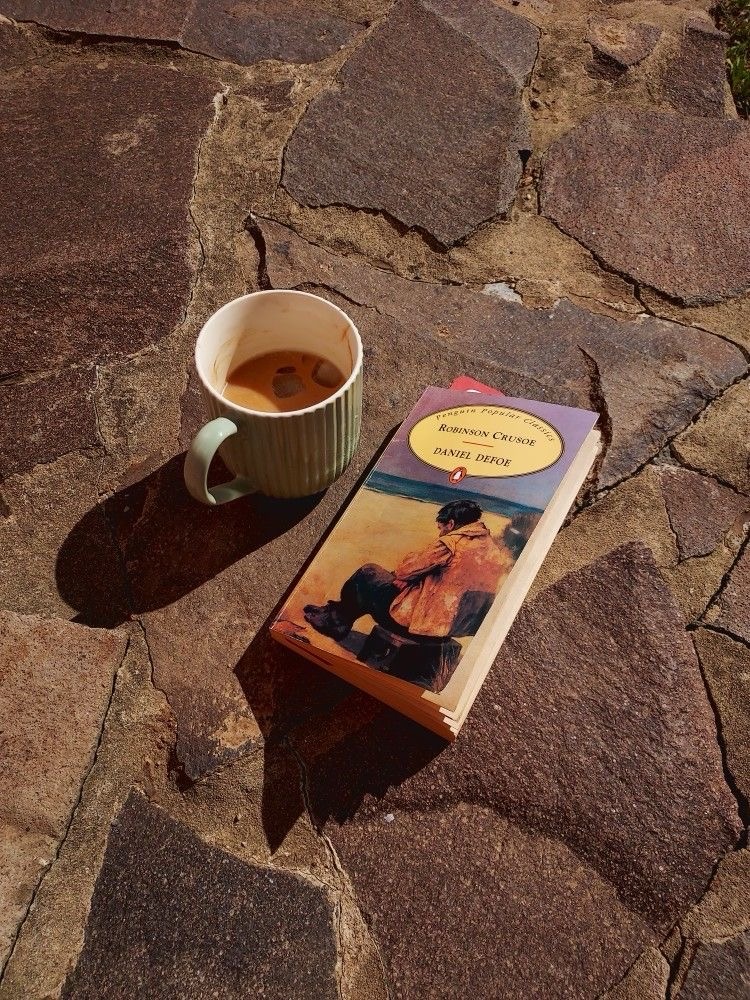
Tap the picture to see it full size
I am not goong to lie and pretend myself the gifted scholar of literature that I am not.
I live criticism and I love stories.
But even the greatest of scholars who dwell in the joy of finding joy in the unjoyous of tales agree that Robinson Crusoe is by far the most boring pice of literature to ever exist. Not only is it monotonous but its lacklustre to say the least.
It was not until my second year, and thanks to My Professor Sengupta, that I had to read RC for the sake of passing and the sale of reading. I am always glad I did.
The novel was boring, it did not fail my expectations there at all. But thats what I learned, It is a boring novel now, because we have other novels to compare it to. What we as contemporary readers fail to grasp is that Robinson Crusoe and Daniel Defoe are what made novels possible in the first place.
Robinson Crusoe is the first Novel. Thats right, it stands at the foundation of the prosaic form of writing that later authors like Austen and Hardy thrive upon. It was the first to deflect from the long standing, monopolistic tradition of epics and poetry.
The most basic format was not followed, it was developed, against the dominant culture of poetry that stood as the centre of literature at that point of the 17-18th century. Poetry was grand, it was the mode of expression of the aristocracy. It was for the upperclass.
Bit with industrialisation and the consequent rise and emergence of a new class of workers that was becoming increasingly larger in demography,
the need for representation for this middle class became required. The middle class, as described in the bery beginning of the narrative, seeks the middle of the extremes, the need to stay.
As such, both the form and the jarrative advocates this middle class ideology reflective of capitalism, individualism, enterprise, puritan ethics and the mastery over the environment that this middle class enters.
The protestent work ethics are my favourite woven threads in the story, the obvious listing bringing an order by the means of science, the binary, the colonisation, the seeking of a pattern through the method of this diary entry, the seeing of the rewards becoming greater as the struggles rise all fall under this amazing knit work that uses its form as well as its story for the purpose of its themes.
When reading a book you find boring, do you
Your vote is final.
Written by
Sumaika bint ZohairMore by Sumaika bint Zohair
Short link: hurroz.com/c/OX4LT
what a beautiful thought I toldly agree with you
boring beginnings , revolutionary literature foundations indeed
That is such a brilliant literary observation. Robinson Crusoe truly laid down the concrete, granular foundation of realistic prose—documenting everyday survival, exact measurements, and mundane details—that later paved the way for the rich psychological depths of Austen and Hardy. Paired with a warm cup of coffee sitting on rustic stone under the sunlight, it creates the ultimate scene of slow, intentional reading. There is nothing quite like losing yourself in the roots of narrative history on a quiet afternoon.